Part 1: Learnings from the Book "Ashtavakra Gita in the Light of Kriya Yoga" by Lahiri Mahasaya

Updated: May 1
The Book Appears
I came across this book while writing a blog on the Ashtavakra Gita and Kriya Yoga, based on the marble plates in Lahiri Mahasaya’s family home.
A small 125-page book, written by Lahiri Mahasaya, offers a unique perspective — seeing the Ashtavakra Gita in the light of Kriya Yoga. He has written many books, all “in the light of Kriya Yoga.” Every author writes from a perspective. His perspective is Kriya Yoga.

I have read the book once, to partly understand what is written. It is like diving into a deep ocean to know about marine life — only limited by my ability to go deeper and further, which comes with study and practice. It is clear that there is a long way to go for me.
When I had AI review all my blogs and tell me where I stand and what to do next, one thing became clear — the dharana stage has to be established firmly. Dharana is focus on a single point. As I read this book, kutastha, paravastha, after-effect poise, and khechari all became clearer. With dharana set, the samyama of all 3, dharana, dhyana and samadhi can be together.
This is the most valuable takeaway from the book. It is to be noted that “doing” becomes “being” as you practise:
• Sitting still becomes natural once asana practice is established.
• Breath becomes slower with pranayama.
• Interest in external objects reduces with pratyahara — my current state.
• Now it is time to establish dharana.
The Ashtavakra Gita has nothing to understand. If you get it, you do. Otherwise, multiple readings are not of much use.
This blog is written with my limited understanding. If you have the book, it is best to refer to it while reading the blog. If you don’t have it, that’s okay — the key learnings are interpreted in the shadow of my limited intelligence. I am yet to see the light. Literally!
Ashtavakra: the meaning:
The common meaning of this word is 8 bends. However, a deeper dive, makes one realise, it is far beyond just 8 bends in the body. The word is at best symbolic.
The deepest valence of vakra is astronomical. A vakra-graha is a planet in retrograde — and a planet in vakra is not actually moving backward. It only appears reversed because of parallax from the moving observer. Vakra is the precise Sanskrit term for apparent reversal as a function of the observer's standpoint. Ashtavakra means eight apparent reversals — eight distortions that exist only in the parallax of the unliberated seer. The sage is not bent. The seeing is bent. The name encodes its own resolution: his "deformity" was never in him; it was in the eyes that mistook the vehicle for the rider. Janaka's courtiers laughing is the universe laughing at itself for the same parallax error every embodied being makes about itself.
Now the womb-curse story which is commonly known. He was bent because he corrected his father's recitation eight times — bent precisely by the act of cognizing crookedness in another. Truth-cognition leaves a wound on the vehicle through which it speaks. The body bears the cost of the correction; the speaker through the body is untouched. When we correct something or someone, the energies clash. The higher one prevails. Though the soul was pure, body was very delicate in the womb. It borne the brunt. Only the annamaya (gross body) kosha was affected, leaving the other 4 intact. This itself confirms the divinity of the sage, even before birth!
Vakra's opposite is "rju" — straight, direct, and similar with "ritam", cosmic order itself. The straight is the true. What Janaka receives is the most rju teaching in the entire Sanskrit corpus — nothing to do, nothing to attain, no path, no traveler, no method, you are already That. The most direct teaching ever delivered comes through the most curved form. This is not coincidence; it is the teaching's own self-demonstration. Do not look at the form to find the truth. Form is always vakra. Realization is always rju. The two coincide here precisely so the disciple stops blending them.
This is also why the name carries Patanjali's "ashtanga" in inversion. Patanjali offers eight limbs as a ladder. Ashtavakra's name takes the same eight and renders them vakra — bent, looped, surpassed, shown as unable to reach what was never absent. The Ashtavakra Gita is the most uncompromising rejection of sadhana in the canon, and its teacher is named for the eight (limbs, steps, practices, methods) made crooked, made null. No straight path of eight reaches what is already the case. The point to note here, is that the teachingis for janaka, who has now gone beyond any effort. Rejecting sadhana altogether is being stupid at best. Everything has a propose and when the purpose is fulfilled, it loses its significance. This is what is meant in this context.
From the viewpoint of Kriya, the resolution is sharper still. In kriya, the spine- meru danda must be made rju — the spine straightened, prana gathered from its scatterings into the central channel. Vakra-meru is the unawakened pranic configuration; rju-meru is sushumna-pravesha. The sage's bent body literalizes the unawakened state at the level of vehicle. — the Self is recognized untouched even in the bent column. Kriya straightens for those who need straightening. The witness was never inside the column to be straightened.
In Tantra philosophy, Ashta-pasha (literally "eight nooses" or "eight bonds") refers to the eight fundamental fetters or limitations that bind a jivatma (individual soul) to the material world and a false sense of self (ego), maintaining the state of pashu-hood. 1. Ghrina — Aversion, hate, or contempt for others. 2. Shanka — Doubt, suspicion, or lack of confidence in the ultimate reality. 3. Bhaya — Fear, specifically the fear of losing temporary possessions or life. 4. Lajja — Shame, or the tendency to hide one’s inadequacies and true nature. 5.Jugupsa — Disgust, censure, or severe reproaching/criticism. 6.Kula — Attachment to family lineage, social standing, or groups. 7.Shila — Adherence to superficial or artificial conduct, excessive pride in morality. 8. Jati — Pride of birth, caste, or race. The one who used bent all the pashas is ashtavakra.
The Book Chapters: An Overview of the Structure
1. Atmanubhava — Realizing the Self (Chapters 1–2)
Ashtavakra’s opening instruction to Janaka: You are not the body, not the mind — you are pure witnessing consciousness. In Lahiri’s reading, this maps directly to kutastha realisation — recognising the witness at the ajna centre as one’s true identity. The after-effect poise is the experiential entry point into this.
2. Upadesha — Advice / Ullas — Joy (Chapters 3–4)
Janaka’s first recognition of freedom. The joy that arises is not emotional — it is the natural condition of awareness released from identification. In Kriya terms, this is the first taste of paravastha.
3. Laya Chatushtaka — The Four Dissolutions (Chapters 5–8)
The most technically significant section for a Kriya practitioner. The four dissolutions describe how individual consciousness progressively merges — from body identification through pranic, mental, and finally causal dissolution into pure awareness. This is Lahiri’s Kriya map expressed in Vedantic language.
4. Anubhava — Realisation (Chapter 9)
Direct experience beyond conceptual understanding. The shift from knowing about the Self to being it.
5. Bandhana and Moksha — Bondage and Liberation (Chapters 10–11)
Desire is bondage. Not the objects — the movement toward them. Liberation is not a state to be achieved but the recognition of what was never bound. Lahiri consistently read this through the Kriya lens: the restless breath is bondage, the still breath is liberation.
6. Ashta Nirvada — Eight Tranquilities (Chapter 12)
Janaka’s eight successive recognitions of his own establishment. Each “I am now established” maps to a progressive deepening of the witness state — in Kriya terms, the consolidation of paravastha across different life conditions.
7. Upasana — Inwardness (Chapters 13–14)
The liberated sage lives naturally, without effort, without rule-following. Inwardness is not withdrawal from life but the unbroken background awareness underneath all activity. This is sahaja samadhi in practical terms.
8. Nirvikalpa — Eternal Tranquility (Chapters 15–16)
Beyond savikalpa (meditation with object) to nirvikalpa (objectless awareness). Lahiri’s key point: technique eventually exhausts itself into this. Kriya is the raft — nirvikalpa is the other shore.
9. Jnana and Shanti — Knowledge and Peace (Chapters 17–18)
The longest and most comprehensive section. The description of the jivanmukta — liberated while living. Chapter 18 of the Ashtavakra Gita is arguably the richest portrait of sahaja realisation in any text. Lahiri’s commentary connects this directly to the Kriya practitioner who has moved beyond technique into continuous natural abidance.
10. Tattva Swarupa — Essence of Consciousness (Chapters 19–20)
Janaka’s final declarations — the total dissolution of all reference points. Not even liberation, not even non-duality, not even silence. Pure being beyond all categories.
11. Shanti Shataka / Vishranta / Jivanmukta
The closing sections — one hundred verses on tranquility, and the nature of the embodied liberated being. The practical face of everything that preceded.
The Central Thesis
The reason I found the Ashtavakra Gita inscribed at Lahiri’s ancestral home — and not the Bhagavad Gita or any other text — is precisely what this book reveals:
The Ashtavakra Gita describes the destination that Kriya Yoga is the path toward.
It does not prescribe technique — it describes what happens when technique has done its work and dissolved itself. Lahiri’s commentary essentially reads each verse as pointing to a state that the sincere Kriya practitioner will recognise from their own experience — not as philosophy, but as phenomenological reality.
How This Blog Was Written:
The way this blog was written is by reading the English text of the book — my Sanskrit knowledge is close to zero. While reading, if there was something that was understood at that point, it was written down. This reading was usually done a few pages every day.
It is interesting to note that earlier texts in Sanskrit were brief. Their commentaries are getting longer and longer.
For example, the Yoga Sutras are a collection of very brief sentences. To understand them, you need great depth. When a student doesn’t have that depth, the guru explains each sentence into a full chapter, spanning multiple pages.
When something has to be explained in more words, it is not a sign of greater intelligence. It’s the other way round.
Anyway, I don’t intend to write a commentary on the entire book and make it 2,500 pages.
Active Reading
This brings clarity of the next level. Some questions arise while reading, and answers are sought. This is “active” reading. Social media also encourages active reading, but it’s more impulsive — usually no reflection or study. There are exceptions, mostly in forums where deep experiences are shared and guidance is given based on one’s own journey. But these are few.
So read on.
The After-Effect Poise
Reading this book by Lahiri Mahasaya introduced me to a phrase he uses very commonly: the “after-effect poise” state. Exploring further, I came to know that…
In Kriya Yoga, “after-effect poise” refers to the state of stillness, inwardness, and heightened awareness that naturally follows the active practice of Kriya pranayama. It is considered as important — perhaps more important — than the technique itself.
What it is
After completing the Kriya rounds, the practitioner simply rests in the residue — the inner silence, the subtle current in the spine, the withdrawal of prana from the senses. This is not passive idling; it is alert, witnessing stillness.
Why it matters
The Kriya breathing technique stirs the prana and begins to interiorise it. The after-effect is when that interiorised energy actually settles into deeper states — pratyahara (sense withdrawal), dharana, and sometimes dhyana arise naturally in this window. Rushing out of it cuts the process short.
Its relationship to kutastha and paravastha
In Lahiri Mahasaya’s tradition, this poise is deeply connected to resting in kutastha — the still witnessing centre between the eyebrows — and allowing paravastha (the transcendent state beyond technique) to arise. The technique is the vehicle; the after-effect poise is where the destination is actually approached.
In practice
After the last Kriya round:
• Sit without effort.
• Don’t analyse, don’t measure — just witness.
• Let the breath be whatever it is (it often becomes very slow or suspended).
• Rest in the sense of presence — of the inner sound or light, if present.
• Remain there as long as the pull sustains.
Lahiri Mahasaya’s emphasis
He consistently pointed students away from technique-obsession and toward resting in the result. The aphorism often quoted in his lineage — “be still and know” — is essentially the instruction for this poise.
It is, in a sense, the bridge between sadhana (practice) and sahaja samadhi (natural, effortless abidance) — the gap where grace enters.
The phenomenology
The after-effect poise — paravastha — is the essential, still state of meditation that occurs after practising Kriya techniques: intense calm, inner silence, and bliss. It is the “being” phase, where one feels the subtle prana in the spine, often marked by a tranquil, suspended breath (kevala kumbhaka) and total absorption.
Practitioners often experience heavy or warm hands, a feeling of stillness, lip tingling, reduced heart rate, and pressure along the spine.
The goal
The primary aim is to transition from the “doing” of Kriya techniques to “becoming” — soaking in the divine state, which prepares one for samadhi. Lahiri Mahasaya encouraged walking, sitting quietly, or resting in that calmness after Kriya, rather than jumping back into worldly activity immediately.
Satyayuga
This state is symbolically equated to Satyayuga — a golden age of truth and peace. As time itself is within us, we move from Kaliyuga to Satyayuga through inner purification. This state is meant to be cultivated until it can be maintained throughout daily life, not just during formal practice.
Mahasaya — The Title
I was intrigued by the title Mahasaya. I had heard of paramhans, swami, and rishi, but not this one. Exploring further, I realised that…
The literal meaning
• Maha = great
• Ashaya = receptacle, container, seat, disposition, intention, heart-space
So Mahasaya literally means “great receptacle” or “large-minded one” — one whose inner space is vast, whose heart contains everything without contraction.
Aashaya goes deeper
Ashaya in Sanskrit is not merely “mind” in the ordinary sense. It carries the meaning of:
• the underlying disposition from which all thought and action arise
• the karmic reservoir — the deep storehouse of samskaras
• the heart-space as a container of consciousness
• the intention at the deepest level of being
So Mahasaya is not simply “broad-minded” in the casual English sense. (English can never quite capture the nuance of Bhartiya languages.) It points to something more precise and deeper — one whose deepest dispositional ground is vast, uncontracted, spacious. Not intellectually broad. Existentially vast. This is the key. One word says it all.
From spontaneous recognition to title
His disciples gave him this title not as a formal institutional award, but as a spontaneous recognition of what they experienced in his presence.
What they were pointing at:
His inner space was felt as boundless. People from every caste, religion, and background — Hindus, Muslims, Christians, kings, servants, gardeners — approached him and felt immediately received, without judgment, without contraction on his part. The vastness of his ashaya was something felt, not merely observed.
He contained contradictions without conflict. Householder and paramhansa simultaneously. Fully engaged in family, work, ordinary life — and simultaneously in continuous samadhi. The Mahasaya was the inner space large enough to hold both without either cancelling the other.
His teaching operated from that space. He didn’t instruct from a position of superiority or distance. The transmission happened because his ashaya — that vast inner container — created a field in which the student’s own deeper nature could recognise itself.
The yogic perspective of the title. In the Yoga Sutras, ashaya appears specifically in the context of karma and samskara storage. The karmic receptacle — the deep unconscious repository of impressions — is what drives rebirth and bondage.
A Mahasaya is one whose ashaya has been so thoroughly purified and expanded that it no longer functions as a storehouse of binding karma. The receptacle has become so vast it is essentially transparent — like a vessel so large that whatever is placed in it is lost, dissolved, unable to accumulate.
This is the yogic precision beneath the honorific. Lahiri’s inner receptacle had been purified by Kriya to the point where karma could not bind him. The great ashaya is one that holds everything and is bound by nothing.
Bhupendranath Sanyal Mahasaya (1877–1962): A direct disciple of Lahiri Mahasaya, he is considered one of the most advanced disciples who received authorization to teach. He is often called "Sanyal Mahasaya" and was recognized as the youngest Acharya in the traditional line. He served as a householder yogi (similar to Lahiri Mahasaya), authored a noted commentary on the Bhagavad Gita, and initiated many, including Rabindranath Tagore.
Other Mahasayas
I wondered if there were other Mahasayas in other traditions. Mahendranath Gupta — the recorder of The Gospel of Sri Ramakrishna — is also referred to as “M” or Mahasaya by Ramakrishna devotees. Ramakrishna himself gave him the title for similar reasons — the vast, receptive, humble inner quality.
So it appears that "mahasaya" is not exclusive to kriya lineage.
This title in the Bengali spiritual tradition specifically points to this quality of inner receptivity and spaciousness — not scholarship, not austerity, not miraculous powers, but the sheer vastness of the inner container.
The deepest reading
In the light of Advaita and the Ashtavakra Gita, Mahasaya points to something even more fundamental:
The ultimate ashaya is consciousness itself — the infinite space in which all experience arises. A Mahasaya is one who has recognised their identity as that space, rather than as the contents arising within it.
Janaka’s declarations in chapters 19 and 20 of the Ashtavakra Gita — “I am established in my own glory, there is no past, future, present, no self or non-self” — are the declarations of a Mahasaya in this deepest sense. One whose ashaya has expanded to the point of being indistinguishable from the infinite.
Lahiri Mahasaya’s title is thus not merely an honorific. It is a precise phenomenological description of what Kriya Yoga had accomplished in him — the complete expansion and purification of the inner receptacle until it merged with the boundless.
The transformation from Shyamacharan Lahiri into Lahiri Mahasaya was through Kriya Yoga practice and the guru’s blessings. This is a role model for all Kriyavans to follow. The blessing is the same for all — the sincere effort makes a difference. It is in our hands to make the effort. Hence the emphasis in our culture on purushartha, not bhagya. Purushartha is about the journey. Bhagya is about being in the same place.
Ashtavakra Gita and Bhagavad Gita
Where is the Bhagavad Gita similar to the Ashtavakra Gita?
Amar Chitra Katha
This was a natural question that arose, as I recollected reading about the sthitaprajna sadhu in Amar Chitra Katha, fifty years back. I remember reading Amar Chitra Kathas at home, on the tree in the garden, and in bed. Every new Amar Chira Katha was something to cherish, and we had almost all of them. 250 or so... neatly bound. I suppose the strong foundation of Sanatana was built then...slowly steadily, in a story format. Maybe the blogs are an expression of this reading in the early days!
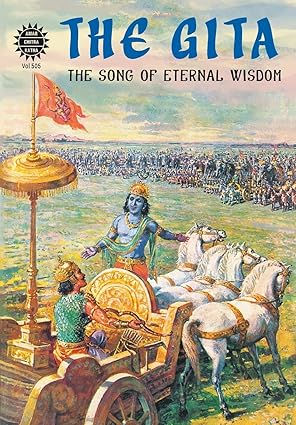
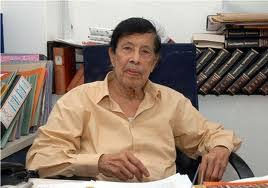
I remember meeting Anant Pai with Vijay, a friend of mine, who used to supply computers to him! It was like a dream come true. He is my idol. Not a cricketer, not a film star, not a businessman, not a politician, but a simple Man, Anat Pai, who brought us in touch with our culture through Amar Chitra Katha picture books. Those were not the days of cameras and selfies. It was 30 years back, maybe! This is how he looked...He must be one happy soul, wondering..."whos remembering me after so many years"?
A profound and underexplored question. The two texts are often treated as belonging to different schools — the Gita as Karma Yoga and Vedanta, the Ashtavakra as radical Advaita. But the convergences are deep and specific.
The illusion of being different
The Gita emphasises action and duty. Ashtavakra seems to dismiss all effort. This apparent contradiction resolves when you understand:
The Gita is speaking to Arjuna before realisation — prescribing the path. Ashtavakra is speaking to Janaka after realisation — describing the destination. They are not contradicting each other. They are addressing different points on the same journey.
Lahiri Mahasaya’s genius was precisely this — he read the Gita not as a prescription for the unrealised, and the Ashtavakra Gita not as reserved for the already realised, but as two illuminations of the same Kriya territory — the Gita describing the approach, the Ashtavakra describing the arrival.
Evidence of direct convergence
1. The Witness Self — Nishkriya Atma
Gita Chapter 2 (Sankhya Yoga) — verses 17–25
The Self is unborn, undying, uncut, unburnt, immovable, eternal. This is the foundational declaration — identical to Ashtavakra’s opening instruction to Janaka: you are pure consciousness, the witness, not the body.
Ashtavakra 1.3–1.7
You are not earth, water, fire, air, or ether. You are the witness of these. You are always free.
Both texts open with this identical move — establishing the absolute nature of the Self before anything else is said. Everything that follows in both texts flows from this.
2. Nishkama Karma — Action Without Doership
Gita Chapter 3 (Karma Yoga) and Chapter 4, especially 4.18–4.20
The one who sees inaction in action and action in inaction is wise. He who has abandoned attachment to the fruits of action — always satisfied, not dependent on anything — though engaged in action, does nothing at all.
Ashtavakra 18.25
This action was done by the body, but not by me. The pure-natured person, thinking like this, is not acting even when acting.
This is perhaps the most direct convergence. Both texts arrive at the same paradoxical conclusion — the realised being acts fully in the world while being completely untouched by action. The mechanism is identical: dissolution of the sense of doership.
3. Sthitaprajna — The Steady Wise One
Gita Chapter 2, verses 54–72
Arjuna asks: what is the description of one established in steady wisdom? Krishna’s answer — undisturbed in sorrow, without craving in pleasure, free from passion, fear, and anger, unattached everywhere — is one of the Gita’s most celebrated passages.
Ashtavakra Chapters 17 and 18, extensively
The entire description of the jivanmukta in Ashtavakra parallels Krishna’s sthitaprajna verse by verse. Same qualities — unaffected by praise or blame, same in pleasure and pain, purposeless gaze, vacant behaviour, acting without acting.
Lahiri Mahasaya’s commentary on both texts essentially reads these sections as describing the same human condition from two different angles.
4. Gunatita — Beyond the Three Gunas
Gita Chapter 14 (Gunatita Yoga) — verses 22–27
The one who has transcended the three gunas — sattva, rajas, tamas — is indifferent to their operations, unmoved, seated as a witness, knowing that the gunas alone act. This is one of the Gita’s most Advaitic chapters.
Ashtavakra 1.6, 17.15–18
Righteousness and unrighteousness, pleasure and pain, are purely of the mind and no concern of yours. There is no distinction between pleasure and pain, man and woman, success and failure, for the wise man who looks on everything as equal.
Both point to the same state — not suppression of the gunas, but transparent passage through them without identification.
5. Kshetra-Kshetrajna — Field and Knower of Field
Gita Chapter 13 (Kshetra-Kshetrajna Vibhaga Yoga)
The body is the field. The one who knows it is the knower of the field. I am the knower of the field in all fields. This is one of the Gita’s most direct non-dual declarations — consciousness as the single knower pervading all bodies.
Ashtavakra 2.1–2.10
As I alone give light to this body, so I do to the world. All this which has emanated from oneself is no other than oneself — like waves from water, cloth from thread, sugar from sugarcane.
Both texts point at the same recognition — individual body-consciousness is a contraction of the one universal consciousness, and recognising the knower dissolves the apparent boundary.
6. Brahma-Nirvana — Dissolution into the Absolute
Gita Chapter 2 verse 72, Chapter 5 verses 24–26, Chapter 6 verse 15
Brahma-nirvana — extinction in Brahman — appears repeatedly as the Gita’s term for the final state. Established in Brahman, serene, the yogi attains supreme peace.
Ashtavakra Chapters 19–20
Janaka’s final declarations — I am established in my own glory. No past, future, present, space, eternity, self, or non-self. Pure being beyond all categories.
Both arrive at the same apophatic endpoint — not describable by any positive attribute, only by the dissolution of every reference point.
How the chapters come together for reading
Bhagavad Gita | Ashtavakra Gita | Theme |
Ch. 2 (v. 17–25, 54–72) | Ch. 1, Ch. 17 | Nature of Self, Sthitaprajna |
Ch. 3–4 | Ch. 18.25–18.29 | Actionless action, non-doership |
Ch. 13 | Ch. 2.1–2.10 | Field and knower, one consciousness |
Ch. 14 | Ch. 1.6, Ch. 17.15 | Beyond gunas |
Ch. 5 (v. 24–26) | Ch. 19–20 | Brahma-nirvana, final dissolution |
Ch. 6 (v. 10–15) | Ch. 12 | Established in meditation |
Ch. 18 (v. 51–56) | Ch. 18 entire | Jivanmukta — liberated in life |
The takeaway
Gita Chapter 18 verses 51–56 and Ashtavakra Chapter 18 in its entirety are perhaps the single most direct parallel in both texts — both describing the fully liberated sage in practical, observable terms. Reading them side by side is a powerful practice in itself.
What is covered in six verses in chapter 18 of the Bhagavad Gita is in one hundred verses in the Ashtavakra Gita — explaining every possible aspect, viewpoint, experience, and example of this state. This is the most profound chapter, on which an entire blog is based. Each time I read this chapter, I feel something inside me that makes me write. But after a point, I have to stop, for the sake of brevity.
A divine indication
Maybe this is the indication to start studying the Bhagavad Gita next.
So far, I have only studied:
1. Nirvanashatakam
2. Shiv Manas Puja
3. Mandukya Upanishad
The Ashtavakra Gita is the next full text I am studying, by intuition. It is interesting to note that none of these — including Shiv Manas Puja — is about bhakti as such. It is all about going inward, into the Self.
A Wider Comparison: Advaita, Buddhism, Jainism, Sikhism
I don’t practise these other paths, but reading them alongside Ashtavakra makes the contours of each sharper. Every perspective is right in its own way, and each is experienced at different stages. There is no journey as such — as awareness deepens, even the notion of “experience” begins to dissolve.
When traditions are compared, there can be differences in books, practices, rituals, and dress — but the focus has to be on the underlying fundamental principles, to appreciate similarities and differences objectively.
Where they are similar
All four arise from a shared cultural soil where different paths and philosophies emerged, each relevant in its time.
• Bondage is real, liberation is possible, and the root of bondage is the misidentification of the self with what is not the self — call it ego, ahankara, atta, haumai.
• Each tradition treats ordinary experience as a kind of structured forgetting, and each prescribes a remembering.
• All four, in their own way, speak of a state beyond the discursive mind, accessible through inward turning rather than outward acquisition.
• All four are, at root, suspicious of pure ritualism as a means to that state. Ashtavakra dismisses sadhana for the awakened; the Buddha relativised Vedic sacrifice; Mahavira treated external rites as inadequate without inner purity; and Nanak’s critique of empty Brahmanical and Islamic forms is foundational to Sikhism.
• There is also a shared structural insight — the witness, by whatever name, is not what it witnesses. Ashtavakra’s sakshi-bhava, the Buddhist recognition that consciousness is not its contents, the Jain upayoga (the soul’s pure knowing-quality, distinct from karmic accretions), and the Sikh notion of the jot (divine light) within — all gesture toward a luminous awareness that is structurally prior to the modifications appearing in it.
Where they sharply diverge — and this is where it gets interesting
The most consequential split is over the nature of the Self.
Ashtavakra’s position is the purest advaita of the four. The Self (Atman) is identical with the absolute (Brahman), and that Self is not many — there is no plurality of selves to begin with. Tat tvam asi taken to its uncompromising extreme. The world, the seeker, the sought, even the path itself, are appearances within the one undivided awareness. Practice becomes almost paradoxical at the highest pitch — there is no one to be liberated.
Buddhism, especially in its early Pali form, takes the opposite tack. There is no Atman at all. Anatta is not a thinned-out version of the Vedantic Self — it is a direct repudiation of it. What you take to be the self is a momentary aggregation of khandhas, dependently arisen, intrinsically empty. That said, certain Mahayana developments — Yogacara’s pure mind, the tathagatagarbha (Buddha-nature) traditions, Dzogchen’s rigpa — converge phenomenologically with Advaita to such a degree that the philosophical disagreement can feel almost terminological. The Tibetan and Vedantic mystics often sound like they are describing the same territory in different vocabularies, even as their metaphysical commitments differ.
Jainism is the most pluralistic of the four, and in a strict sense not advaitic at all. There are infinitely many jivas, each beginningless and eternal, each capable of liberation independently. Reality is genuinely many. The soul’s pure nature — infinite knowledge, perception, bliss, energy — is uncovered by removing karmic matter through ascetic discipline. Where Ashtavakra says you are already free and need only recognise it, classical Jainism says you are encrusted and must scour. Different ontology, different soteriology.
Sikhism occupies an intriguing middle position. Ik Onkar — “One Reality” — is genuinely non-dual in spirit, and Guru Nanak’s vision draws on the Sant tradition that itself synthesised Vedantic and Sufi non-dualism. But Sikh theology preserves a devotional relationship with the divine that pure Advaita dissolves. The soul is to merge with the Beloved, not to recognise that no separation ever existed. In some readings, this is closer to vishishtadvaita (qualified non-dualism) than to Ashtavakra’s radical position. The practice — naam simran, seva, life in sangat as a householder — also differs sharply from Ashtavakra’s ascetic-jnani flavour or Jain renunciation.
A useful perspective on liberation
• Jainism preserves the individual soul fully — eternally distinct.
• Sikhism preserves the devotee in loving union with the One.
• Buddhism dissolves the self entirely, leaving only the cessation of clinging (with Mahayana adding Buddha-nature as a kind of luminous ground).
• Ashtavakra denies there ever was a separate self to dissolve — only the ever-present, undivided Self that you already are.
How the fundamentals shape the path
Each tradition’s ethics, meditation methods, and view of the world fall out from this central commitment.
• The Jain emphasis on ahimsa makes sense if every jiva is irreducibly real and worthy.
• The Buddhist emphasis on karuna makes sense once self-grasping is seen through.
• The Sikh emphasis on seva makes sense within a relational theism.
• And Ashtavakra’s almost ethics-transcending tone — that startling indifference even to liberation itself — makes sense only if there is, finally, no other.
The traditions are not saying the same thing in different words. But they are circling the same wound — the ache of apparent separation — and each offers a coherent map out, valid within its own metaphysical frame.
Among these, Ashtavakra’s position is the one Kriya Yoga is aimed at experientially, not philosophically. The technique itself does not argue — it simply takes the practitioner toward the recognition the verses describe.
Closing
Before the verses themselves, then, this is the territory: a small book, a vast title, and the same destination glimpsed from many directions.
The next parts walk through the verses.

Comments